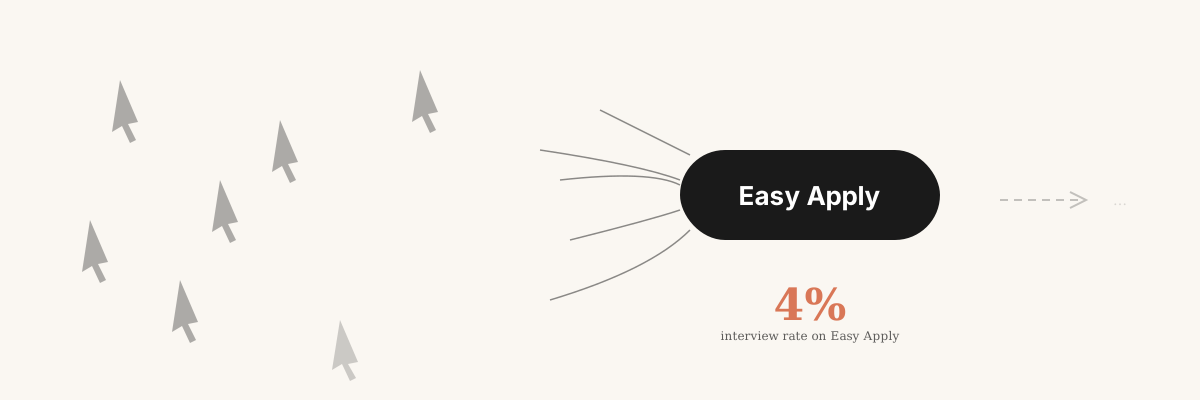
Three hundred Easy Apply submissions. Zero interviews. LinkedIn keeps telling you you are a "top applicant."
If that is your current reality, you are not alone and you are not bad at applying. The tool is working exactly as designed. Just not for you.
Easy Apply looks like the answer to the job-search problem. You apply to a role in two clicks. You apply to 50 roles in an hour. You feel productive. You feel like the numbers are on your side. A week goes by. A month. Nothing.
Here is what is actually happening.
The math nobody explains
- Roughly 95% of Easy Apply submissions get no response. Not a rejection, not an interview — silence.
- The interview rate on Easy Apply is about 4%, versus roughly 12–15% for applications submitted through a company's own careers page.
- Since 2022, Easy Apply submissions are up ~40% — and response rates are down ~25%. More applicants competing for the same roles means the median applicant has gotten more invisible, not less.
- On any given well-known role, the first 2 hours after posting typically collect 200–800 Easy Apply submissions.
You are not in a race against the ideal candidate. You are in a race against 500 other people who pressed the same button you did in the same 120-minute window. The recruiter does not have 500 slots. They have 15.
What "Top Applicant" actually means
LinkedIn shows the "Top Applicant" badge to a much wider group than the name suggests. It's an indicator that, based on LinkedIn's surface-level matching, you meet more of the listed criteria than average. That's a low bar. In practice, dozens (sometimes hundreds) of applicants get the same badge on the same posting.
A common sentiment from r/jobs and r/recruitinghell: "'Top applicant' means nothing. LinkedIn shows that to everyone."
The badge isn't dishonest exactly — it's just measuring something different from what you think it's measuring. It tells you "you cleared the basic bar." It does not tell you "you're likely to get the interview." The gap between those two claims is where your weekend went.
Why the tool is built this way
Easy Apply is not a hiring tool. It is an engagement tool. Every click keeps you on LinkedIn. Every notification ("3 new jobs match your profile!") pulls you back. The product is designed to make applying feel frictionless — because friction would reduce the number of applications, which would reduce the number of sessions, which would reduce ad revenue.
From the employer's side, Easy Apply is worse than you'd hope. Recruiters get a flood of applications where they can't tell who actually read the job description from who was mass-applying. Their defense is to weight Easy Apply submissions lower in the stack — or ignore them entirely in favor of applications that came through the company's ATS, where the applicant had to do real work.
Several 2025 surveys of recruiters found that a plurality now treat Easy Apply candidates as a separate, lower-priority pool. The shortcut you're taking is being routed around.
The specific failure modes
Beyond the structural issues, Easy Apply has some very specific, very preventable problems:
1. Your old resume is attached to half your submissions
LinkedIn autoselects the most recently uploaded resume. If you updated your resume last week but clicked Easy Apply fast, you may have sent an old version — one missing your recent role, or with an objective statement you wrote in 2022.
A viral r/jobs post from late 2025: "I realized Easy Apply attaches my old resume from three jobs ago to half my submissions. No wonder I heard nothing."
2. The questions are answered on autopilot
Every Easy Apply form has screening questions — years of experience, salary expectations, work authorization. You click through these fast because there are 15 of them and they feel like friction. But those answers feed directly into the recruiter's filter. One wrong click ("no" to a requirement you actually meet) and your application is auto-rejected without anyone reading the resume.
3. The cover letter field gets skipped
Easy Apply lets you skip the cover letter. You skip it because the button says "Optional." On the recruiter's side, "Optional" means "we'll weight the people who filled it in higher." You've just self-selected into the lower pile.
4. You're competing against tailored applications
For any role worth having, the serious candidates applied through the company's ATS with a tailored resume. Easy Apply sends you into a pool that has already been sorted beneath them. You're competing for the attention the top applicants left over.
What to do instead
1. Cap Easy Apply at 10% of your effort
Use it only for low-stakes, high-volume practice — roles you're mildly curious about but wouldn't mourn. The other 90% of your time goes to direct applications through company careers pages with tailored materials.
2. For any role you actually want, do the work
That means:
- Pull up the job description. Read it twice.
- Rewrite the top third of your resume to match the top third of the JD.
- Write a two-paragraph cover letter that names the role, names one specific thing about the company, and explains in one sentence why this role specifically fits your trajectory.
- Apply through the company site, not LinkedIn.
- Find the recruiter on LinkedIn and send a short, specific message noting your application.
This takes 30–45 minutes per role. At ten roles a week, that's 5–8 hours. You will have far better odds than 300 Easy Applies.
3. Use LinkedIn for discovery, not submission
LinkedIn is an excellent way to find jobs. It is a mediocre way to apply for them. Let it tell you what's out there. Then go to the company's own site to actually apply.
4. Message recruiters with specificity
"I applied for the Senior PM role — here's a 30-second version of why I think I'd fit" converts far better than "are you hiring?" or a blank connection request. Specificity signals you read the JD, which signals you're not one of the 500 Easy Appliers.
5. Track your ratios honestly
If you've sent 100 Easy Applies and gotten 2 interviews (2%), you have a data point: the tool is statistically worse than just not applying. Shift effort to methods where the interview rate is 10%+.
Where shortlisted.site fits
LinkedIn's problem isn't that it shows you jobs — it's that it lets you apply to all of them in a way that makes you indistinguishable from the 500 other people who saw the same listing.
We built shortlisted.site around the opposite principle. For every role, we run a real fit analysis — skills, experience, seniority, location, salary — and tell you where you actually rank. If you're in the top 15 for a role, go hard: tailored resume, tailored cover letter, direct application. If you're median, skip it and save the effort for a role where you stand a chance.
It's the anti-Easy-Apply. Fewer applications. Much higher hit rate. You stop feeling productive for productivity's sake and start seeing responses.
Our users typically go from 300 Easy Applies with 4 interviews to 20 targeted applications with 8–12 interviews. The math isn't magic — it's just that you stopped hiding in a crowd.
You can upload your resume and analyze your first role in under two minutes. No credit card. Try it here.
Easy Apply sells you the feeling of momentum. The cost is that you are invisible at the end of it.
If you are averaging less than a 5% response rate on Easy Apply, and most people are well below that, the tool is failing you. This is not user error or a bad resume or bad luck. It is a structural feature of how Easy Apply is designed.
Do fewer, better, targeted applications. Apply through the company site. Match the JD with real care. Skip Easy Apply for anything that matters. That's the path from 300 submissions and 0 interviews to 20 submissions and 8.