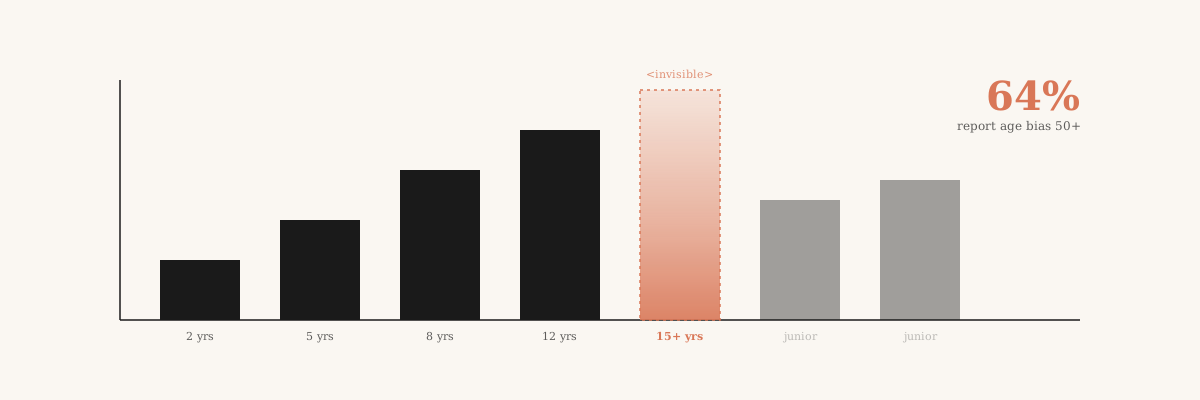
You're 45. You have 15 years of strong experience. Good outcomes. Great references. The last three roles each built on the one before. By every reasonable measure, you're a better candidate now than you were at 35.
So why is your application-to-interview ratio a quarter of what it used to be?
If you're reading this from a kitchen table at 11pm after another silent week, you already know the answer isn't in the resume. It isn't in the cover letter. Something structural has shifted, and the career advice industry keeps giving you the same three tips: drop your graduation year, cut anything older than 15 years, maybe dye your hair before the Zoom.
The advice is about hiding. What you actually need is advocacy. Here is the difference.
The scale of it
The numbers are bleak and the reporting is consistent across sources:
- AARP, January 2025: 64% of workers 50+ reported experiencing or witnessing age discrimination at work.
- August 2024 AARP survey: 59% of workers 50+ said age is an obstacle in job search.
- Callback study, widely cited 2025: resumes with older-sounding names (Donna, Walter) got 36% fewer callbacks than identical resumes with younger-sounding names.
- Mid-career women report the sharpest drop in interview rates — the "menopause penalty" phrase has become mainstream on r/jobs and r/careeradvice, with women in their late 40s and early 50s reporting 3–5x harder job searches than their male peers of equivalent experience.
- Evidence suggests discrimination measurably starts around age 40–45, not 60 — contrary to the common assumption that only "older" workers face it.
This is not in your head. It's in the data.
Why this is happening right now
Three forces are compounding in 2025–2026:
1. Cost-cutting bias
Experienced candidates cost more. In a tight economy, hiring managers pattern-match on "this person will want $180K, I can hire two juniors for that." The bias is explicit in some shops and implicit in most. It's also largely wrong — experienced hires ramp faster and tend to stay longer — but the bias operates before that math gets done.
2. AI-driven rejection
ATSes weight "years in current function" heavily. If you have 18 years as a Director and the role lists "5–8 years of experience," the AI filter may rank you below the top band because you're "overqualified." This reads as a compliment; it functions as a rejection.
A representative sentiment from r/recruitinghell in 2025: "Got rejected for a role I would've run circles around, on the grounds I had 'too much leadership experience for an IC contributor position.' I would have loved to contribute. They never asked."
3. Cultural signaling
Certain industries — tech, creative, early-stage startups — project a younger cultural image. Hiring managers in those industries, often themselves in their 20s and 30s, unconsciously weight candidate energy, "founder fit," "ability to move fast" — all of which are proxies for age.
A quote from a 60-year-old Sales Engineer that surfaced in the 2025 Diversity.com ageism report: "My manager said they wanted someone with 'more energy.' I was outperforming everyone on my team."
Why the standard advice fails
Open any career-advice site for "job search after 40" and you'll get:
- Drop your graduation year.
- Cap your resume at 10–15 years of experience.
- Dye your hair before video interviews.
- Remove anything that signals seniority — "senior," "director," "VP."
- Use a modern template. Don't use old-fashioned fonts.
The problem with this advice is that it asks you to camouflage yourself into a younger candidate — and fails on two counts. First, skilled recruiters can read through it within the first 30 seconds of an interview. Second, you lose the specific thing that makes you valuable: the compounding of 15 years of judgment.
You end up presenting as a vanilla mid-level candidate competing with actual mid-level candidates who are cheaper and a better cultural "fit" on the signal axes the company's filtering on. You lose that game.
A different frame: lead with depth
The answer is not to hide experience. It is to make the experience legible as an asset instead of a cost.
This is about reframing at three levels:
At the resume level
Don't trim 15 years down to 10. Keep the whole story, but restructure it to front-load the last 5 years and the most relevant career arc. Here's what that looks like:
- Summary: one sentence that names your depth as a specific asset. Not "15 years of experience." Instead: "15 years building enterprise SaaS products, specifically the transition from 50-person to 500-person orgs." The specificity converts "old" into "rare."
- Most recent role: 4–6 bullets, each with a concrete quantified result. The bullets should show compound judgment — decisions that required seeing multiple cycles.
- Prior roles: 2 bullets each, max. No descriptions. Just title, company, dates, and 2 sentences of what you did.
- Older roles (10+ years back): a single line each, no bullets. "2008–2012: Senior PM, [Company]." This preserves the arc without spending real estate on it.
The resume becomes a pyramid with the last 5 years as the apex. Your depth is visible but not overwhelming.
At the cover letter level
The cover letter is where you neutralize the age objection before the recruiter can form it.
Don't write "I have 15 years of experience in..." That's the frame the recruiter is already using to downgrade you. Instead, write about why depth matters for this specific role: "This role requires navigating a 3-year platform migration while maintaining customer trust. I've done exactly that migration twice before — once under budget pressure and once under regulatory scrutiny — and the pattern recognition is the reason I'd get it right on the first attempt."
The subtext: you're not expensive. You're cheaper than the mistake a junior would make.
At the interview level
The implicit question in every interview for an experienced candidate is: "Can you actually do the work, or are you going to show up trying to manage us?" Address it directly, usually in response to a behavioral question.
Phrasing like: "I know when to lead and when to execute. For the first 90 days here, the job is to execute and earn trust. I've done this twice before in my last two roles; in both cases the leadership work came later, once I'd earned the context."
You're showing self-awareness. You're defusing the "overqualified" objection without lying about your experience. You're also showing — with the reference to two prior cases — that you've learned by repetition, which is the specific superpower junior candidates don't have.
Practical tactics, no apology required
1. Target roles that explicitly value depth
Not every role discriminates on age. Some actively select for it. Roles that require:
- Navigating regulatory environments
- Leading organizational transformation
- Rebuilding teams after a reorg
- Scaling from startup to midmarket
- Delivering against difficult enterprise customers
...tend to favor experienced candidates because the failure mode of a junior hire is expensive. Spend 70% of your applications on these roles. Spend 30% on roles where you're more typically in the band, not the top.
2. Avoid roles with clear youth signals
If the JD uses phrases like "hungry," "hustle," "move fast and break things," "no ego," "ownership mindset" as the dominant cultural language — those are proxies for youth preference. You may still get it, but your odds are lower. Save your effort.
3. Lean into founder-led and owner-operator companies
Companies where the founder is your age or older, or where the decision-maker has 15+ years themselves, filter less on age. Series-D startups, mid-size private companies, and family-held businesses are often your highest-hit-rate pool.
4. Network as your primary channel
Cold applications are where age discrimination is strongest, because the filter is at its most mechanical. Warm introductions bypass the filter entirely. Your network — peers, former colleagues, former reports — is your single most valuable asset at this stage, and most experienced candidates under-use it because the old advice was "apply more." Flip that ratio.
5. Write a short narrative about your last 5 years
Not your career. Just the last 5 years. What problem you've spent that time solving. What you learned. What you can now do that you couldn't before. Use this narrative in cover letters, in intro messages, in interview responses. It restricts the conversation to the portion of your career that's recent and relevant, without hiding the rest.
Where shortlisted.site fits
Most job-search tools have age bias baked in. Keyword-matchers look for exact experience bands — "5–8 years" — and penalize you for having 15. ATS optimizers tell you to trim your resume down until you look like a mid-level candidate. Auto-apply bots fire your resume at roles where you were never going to get called.
We built shortlisted.site to do the opposite. Our fit analysis treats depth as a signal, not a liability. When you have 15 years of experience and the role asks for 5+, we read that as a top-of-band match — not an "overqualified" red flag — and we surface it that way. We also identify which of your experiences are specifically relevant to the role, so the tailored resume we generate leads with the 4 bullets that make your depth feel like an asset, and tucks the rest into a one-line format.
The cover letters we generate are written to neutralize the age objection rather than feed it — framing depth as rare pattern recognition, not as cost. Our users over 40 consistently report the same thing: their interview rate goes up, not down, when they stop hiding.
You can upload your resume and try a fit analysis on any role in under two minutes. No credit card. Try it here.
You are not invisible because you are old. You are invisible because the tools you are using and the advice you are following are flattening your experience into something that looks like everyone else's.
Lead with depth. Specify what you've done that a 5-year candidate couldn't. Target roles and companies where that depth is the asset they need. Let your network do the heavy lifting instead of cold applications.
Fifteen years is not a liability. It's a rare kind of judgment that the right hiring manager is specifically looking for. Your job is to find them.