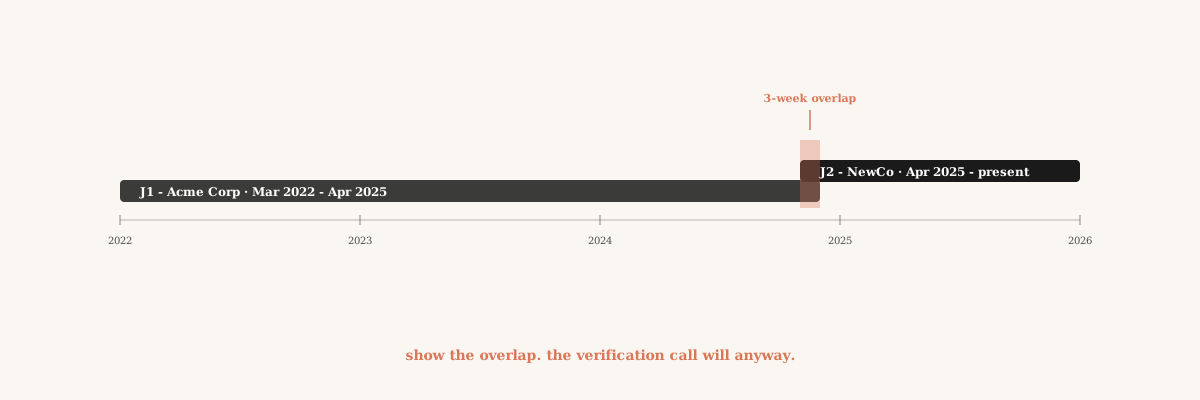
You stayed at your old job (J1) for three weeks while you were already at your new job (J2). Maybe your last day at J1 was extended because you were finishing a project. Maybe you started J2 early at the new company's request. Maybe you were doing a deliberate overlap because the offer terms required it.
Now you are applying for J3, and the resume question gets uncomfortable. Your J1 verification call will return an end date that overlaps with your J2 start date. The verification call for J2 might also surface the overlap. If the dates on your resume look like the two jobs were sequential when they were not, the discrepancy can sink the offer.
This is the J1/J2 overlap problem, and it is more common than the public job-search forums make it look. Most people resolve a transition with a brief overlap, a brief gap, or a vacation between roles. The brief overlap is the one that creates the most resume anxiety and gets the least clear advice.
Here is what actually works.
How background checks read overlapping dates
A standard background check for J3 verifies dates of employment for J1 and J2. Those dates come from the prior employers' HR systems, not from your resume. The HR system will return:
- J1: started [X], ended [Y]
- J2: started [Z], ended [W]
If Z is before Y by any meaningful margin (more than a few days), the verification call returns dates that overlap. The recruiter at J3 sees this. What they do with it depends almost entirely on what your resume said.
Three scenarios.
Scenario 1: Your resume showed clean sequential dates
If your resume claims J1 ended in March and J2 started in April, but the verification returns J1 ending in late April and J2 starting in early April, the recruiter sees a date discrepancy. This is the worst-case scenario. The recruiter does not care that the overlap was three weeks. They care that the resume did not match the verification. Offers get rescinded for date discrepancies even when the underlying reason for the overlap is innocent.
Scenario 2: Your resume showed overlapping dates honestly
If your resume showed J1 ending in late April and J2 starting in early April, the recruiter sees the overlap when verifying. They might ask. The answer is brief and factual ("I extended my last weeks at J1 to wrap up a project while I was already at J2"). The recruiter generally accepts it and moves on. The verification matches the resume. Trust holds.
Scenario 3: Your resume avoided the issue entirely
Some candidates list dates only by year ("J1: 2023", "J2: 2024") to avoid the precision problem. This works in some industries (academic, government, legal) and reads as a tell in others (corporate, tech, consulting). Where year-only dates are normal, this is fine. Where they are not, year-only dates draw the same suspicion that month-level mismatches do.
The right strategy in 2026, for almost all corporate, tech, finance, and consulting roles, is scenario 2: show the overlap honestly with month-level dates. Recruiters at J3 expect month-level precision. Year-only dates read as vague.
The framing that works
Use month-level dates and let the overlap show
Senior Product Manager, Acme Corp
March 2022 - April 2025

Senior Product Manager, NewCo
April 2025 - present
Both entries name April 2025. The overlap is visible in the date column. The recruiter scanning the resume sees it. They either ask, or do not. If they ask, the answer is one sentence.
Do not annotate the overlap on the resume itself
You do not need to write "(brief overlap with prior role to wrap up a project)" on the resume. The dates speak for themselves and the annotation reads as defensive. The cover letter or the interview handles the explanation if needed.
If the overlap is more than four weeks, address it briefly in the cover letter
For overlaps of one to four weeks, the resume's date column is enough. For overlaps longer than that, a one-sentence cover-letter mention is the right move.
"On the dates: I had a four-week overlap between roles in early 2025 because [Acme] asked me to extend through the launch of [project] while I was already onboarding at [NewCo]. Both companies were aware and supportive."
This is one sentence. It is factual. It names a reason. It signals consent from both employers, which is the actual concern most recruiters have when they see an overlap.
When the overlap is not just a transition
Some overlaps are not transitions. They are deliberate two-job arrangements: the candidate worked J1 and J2 simultaneously for months or longer, sometimes intentionally hiding it from one or both employers. The job-search forums call this overemployment. It is a different problem from the brief-transition overlap.
The framing changes.
If both employers were aware
If you held two roles at once with both employers' knowledge (a part-time role plus a full-time role, a consulting engagement plus a full-time role, an advisory plus an operational role), list both with their honest dates. The overlap is fine. The cover letter can mention the dual-role period in one sentence, framing it as deliberate parallel work.
"From May 2023 to August 2024 I held two concurrent roles: a part-time CTO position at [Startup] (advisory plus implementation work, roughly 15 hours per week) and a full-time engineering manager role at [Company]. Both teams were aware of the other engagement and the arrangement was endorsed by leadership at [Company]."
This works if it is true. It does not work if you are retroactively claiming "they were aware" when neither employer actually knew. The verification calls will surface the truth.
If one or both employers were not aware
This is the hard case and the one most-asked about on the overemployment forums. The candidate held J1 and J2 simultaneously for months, with at least one employer believing them to be a single full-time hire.
Two pieces of advice that do not contradict each other.
On the resume: list the dates honestly. Do not back-date or extend dates to make the overlap disappear. Verification calls will surface the truth. Date discrepancies between resume and verification are the single most common reason offers get rescinded after the background check.
On the framing: in the cover letter and interview, do not use the word "overemployed" or describe the arrangement in ways that signal "I was hiding J1 from J2 and J2 from J1". Frame it as a transitional or hybrid period.
"My 2024 included a transitional period during which I was wrapping up a contractual engagement with [Company A] while ramping at [Company B]. Both engagements were within my contracted obligations to each."
The phrasing is honest about the dates and does not invite a question about which employer knew what. If the recruiter asks directly whether both companies were aware, do not lie. If the answer is "Company B did not formally know about Company A but my work for Company B was not affected", say that. Lying about the awareness, even in a verbal interview, can surface in reference calls and is treated as a trust violation.
The harder truth is that if you did extensive overemployment with both employers unaware, recruiters at J3 sometimes pass on candidates with this pattern even when the candidate's work has been excellent. There is no perfect framing that erases this. The honest version of the resume gives you the best chance of advancing through the verification step. Whether the recruiter passes on you because of the pattern is a separate question, and one the resume framing cannot solve.
What to do about LinkedIn
LinkedIn is the second source recruiters check after the resume and before the formal verification. The LinkedIn entry needs to match the resume.
Match dates to the month
If your resume says J1 ended in April 2025 and J2 started in April 2025, your LinkedIn entries need to say the same. A LinkedIn that shows J1 ending in March and J2 starting in May (smoothing the overlap to make it look sequential) is a tell.
Update LinkedIn before you start applying
If your LinkedIn currently smooths the overlap or shows wrong dates, fix it before submitting applications. Recruiters cross-check during the screening step, not after the offer. A LinkedIn that contradicts the resume during screening is a fast rejection.
Use LinkedIn's "Currently working at" feature for parallel roles
LinkedIn allows multiple "currently working at" entries. If you held two simultaneous roles legitimately, set both as current with their honest start and end dates. This is the single cleanest signal that the overlap was deliberate and known.
The interview answer
Most recruiters who notice the overlap on the resume or LinkedIn will ask. The answer is short.
For a brief transition overlap:
"I extended my last weeks at [J1] to finish the [specific project] launch while I was already onboarding at [J2]. The overlap was about three weeks. Both managers were in regular contact during that period."
For a deliberate parallel-role period:
"I held two roles for about [N] months in [year]. The senior role at [Company A] was full-time. The advisory role at [Company B] was about [N] hours per week. Both teams were aware of the other engagement."
For a transitional contracting period:
"I had a contractual obligation to [Company A] that ran into early [year] while I was already at [Company B]. The work for [Company A] was bounded — about [X] hours per week wrapping up [specific deliverables]. [Company B] knew about the obligation when they hired me."
In all three cases, the answer is one or two sentences. It names the employer, the rough duration, and the awareness state. It does not editorialize. The recruiter wants the dates to make sense. Make them make sense.
What not to do
Do not back-date or extend dates
If you altered dates on the resume to make the overlap disappear, the verification call will return the real dates. The recruiter sees the discrepancy. The offer is at risk. The honest resume with the visible overlap is almost always the safer option.
Do not pretend the overlap was longer than it was
The inverse mistake. Some candidates extend the J1 end date to look like a longer tenure, or the J2 start date earlier to look like more experience at the new company. Verification calls catch both.
Do not use the word "overemployed" in interviews
It is a forum term. Recruiters in 2026 know what it means and the term carries connotations of secrecy. Use neutral language ("parallel roles", "transitional period", "concurrent engagements") instead.
Do not avoid the question if it is asked
If the recruiter asks "were both companies aware of the other engagement?", the worst answer is to deflect or change the subject. The recruiter who notices the deflection assumes the worst. A direct, calm answer (yes / no / partially) is almost always better than a deflection.
Do not over-explain unprompted
If the recruiter has not asked about the overlap, do not bring it up in the interview. The cover letter handles the framing. The resume's date column shows the dates. If the recruiter has not paused on it, you do not need to volunteer.
Where shortlisted.site fits
The J1/J2 overlap problem is a small but high-stakes piece of resume framing. Get the date column right, get the cover letter framing right, get the LinkedIn alignment right, and the overlap stops being a story. Get any of those wrong and the offer is at risk after a clean interview process.
We built shortlisted.site to handle exactly this kind of judgment. You give us your real history with honest dates, including the overlap, and the underlying reason. We generate a resume that uses month-level dates, lists both roles with their actual start and end months, and a cover letter that addresses the overlap in one sentence when it is more than four weeks. The framing is calibrated to the recruiter's actual concern: do the dates line up with what the verification will return.
You can upload your resume and try the first tailoring pass free. No credit card. Try it here.
A J1/J2 overlap is rarely a real problem. The verification call is going to return the real dates regardless of what your resume says. The candidates who run into trouble are the ones whose resume claims sequential dates that the verification then contradicts.
Use month-level dates. Show the overlap honestly. Mention it in the cover letter only if it is more than four weeks. Match LinkedIn to the resume to the month. Answer the interview question, if asked, in one or two sentences with neutral language. Do not back-date, do not extend, do not deflect.
The J3 recruiter is not screening for perfect timelines. They are screening for candidates whose resume, LinkedIn, references, and verification all tell the same story. Tell the same story everywhere. The overlap stops mattering.