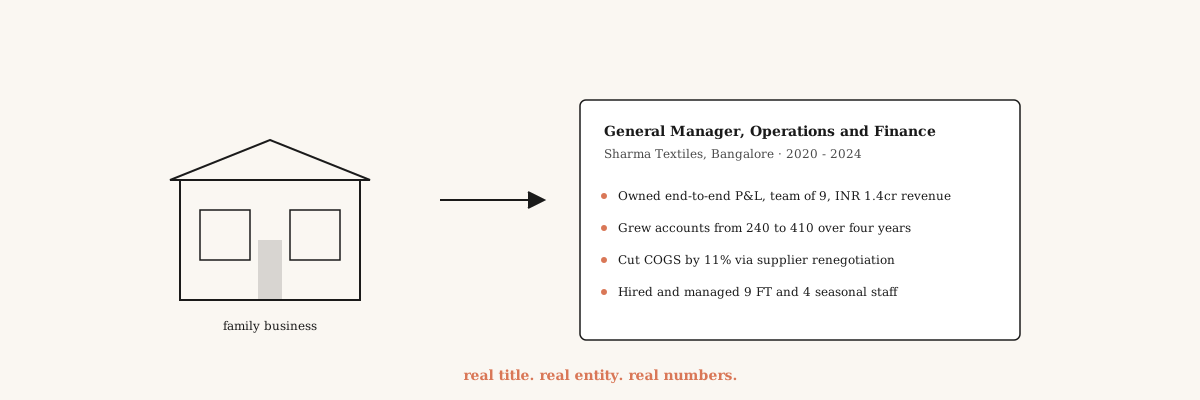
You spent four years helping run your parents' business. You handled the books, dealt with vendors, hired and fired staff, navigated a license renewal, sat through tax audits, learned to read a P&L because nobody else was going to. Then you decided to apply for corporate roles and realized the entire resume of your most-formative work experience reads, in the standard format, as: "Family business, 2020 - 2024".
This is one of the most common but least-discussed resume problems. It comes up in r/jobs, r/careerguidance, r/IndianStartups, r/Entrepreneur, and the South Asian and Latin American immigrant subreddits constantly. The candidate has done substantial work. The resume makes it invisible. Recruiters read "family business" and assume informality, no real responsibilities, no real measurable outcomes.
Almost none of that assumption is true for the candidate. All of it is fixable in the resume.
Here is the framing that works.
Why the default framing fails
The default resume entry for family-business work usually looks something like:
Family business — Bangalore, India
2020 - 2024
- Helped run day-to-day operations
- Managed staff and vendors
- Handled accounting and tax
Every word in that entry is true. Every word also fails to do its job. Three problems:
- No real title. "Helped run" is not a title. "Operations manager", "general manager", "finance and operations lead" are titles. The recruiter scans the title field. If the title field is empty or vague, the role does not register.
- No real entity name. "Family business" is a category, not a name. The recruiter cannot verify the entity, look it up, or anchor the role in any specific industry context. It reads as informal.
- No measurable outcome. "Day-to-day operations" describes the surface of the work, not the result. Compare to the same role described as "Grew the customer base from 240 to 410 monthly accounts and reduced payroll cost as a percent of revenue from 38 to 29 percent over four years." Same job. Different impact.
The fix is to treat the role the way you would treat any other role. Real title, real entity name, real numbers. The fact that the entity was owned by your family is not relevant to the resume entry. It is relevant to the cover letter or the interview, briefly, only if asked.
The four-line replacement
Here is what the entry should look like.
General Manager, Operations and Finance
[Real Business Name], Bangalore, India
March 2020 - August 2024

- Owned end-to-end P&L for a [type of business] with annual revenue of [X] and a team of [N] full-time staff.
- Grew customer base from [number] to [number] over four years through [specific channel/strategy], improving repeat-purchase rate from [X]% to [Y]%.
- Renegotiated supplier terms with [N] vendors, reducing cost of goods by [X]% and lengthening payment terms by [N] days.
- Led the [specific project], including [specific scope]. Outcome: [specific result with number].
Four bullets. Real numbers in each one. A title that names the actual function. The entity name as it appears on the GST registration or tax filing.
The reader does not need to know it was your family's business to evaluate this role. The role evaluates itself. That is the goal.
Picking the right title
The title is the single highest-leverage decision in this entry. Two principles.
Use a title that matches the actual scope, not the name on the company door
If you handled finance, operations, hiring, vendor relationships, and strategy, "General Manager" is a defensible title. If you primarily handled finance and accounting, "Finance Manager" or "Controller" is right. If you primarily handled operations, "Operations Manager". The title is the recruiter's first read on what level you operated at. Pick the title that names the work, not the title that names the relationship.
Do not give yourself a title above what you did
If you were 23 years old and the actual decisions were made by your parents, "Chief Operating Officer" overshoots. The interview will surface the truth and the inflated title will burn the candidacy. Better to be a credible "Operations Manager" than a non-credible "COO".
A useful test: would the title hold up if a former vendor or a former staff member from the business were called as a reference? If yes, use it. If no, scale down.
Picking the right entity name
The business has a real legal name. Use it. "Sharma Textiles", "Patel Imports", "MM Trading Co.". This is the name on the GST registration, the bank account, and the tax filings. It is not "family business" or "small business in Mumbai".
If the business has no legal entity (genuinely informal, no GST, no registered name), you have two options:
- Create a clear descriptive name. "Family-owned wholesale textile distribution, Bangalore" with the years. Treat it as the entity name. This is honest and gives the recruiter something to anchor on.
- Use a sector and location. "Independent retail business, Mumbai (family-owned)". Slightly weaker than option 1 but still better than "family business".
The entity name does the same work as a company name on any other resume entry. It places the role in an industry, a geography, and a category that the recruiter can recognise.
The numbers that matter
Family-business resumes fail most often because they have no numbers. Most candidates assume the numbers are not impressive enough to write down. They are wrong. Even small businesses run real numbers, and recruiters reading the resume calibrate against the small-business benchmark, not against the Fortune 500 benchmark.
These are the numbers that work. Pick three or four for the entry.
Revenue
The annual revenue of the business in the most recent year you ran it. Use the local currency or USD equivalent. "Annual revenue of INR 1.4 crore (USD 170,000)" is a real number. It does not need to be in millions to register.
Headcount
The number of full-time and part-time staff you managed. "Team of 6 full-time and 4 seasonal" is enough. The recruiter is reading whether you have managed people. The answer is yes.
Customers, accounts, units
If the business sold to consumers, the number of monthly or annual customers. If B2B, the number of active accounts. If product-based, units shipped or stock kept.
Growth deltas
Before-and-after numbers on something you specifically changed. "Grew monthly accounts from 240 to 410" is specific and the delta makes the work visible. A flat "managed customer relationships" sentence does none of the same work.
Cost reductions
If you renegotiated supplier terms, reduced spoilage, automated a manual process, cut payroll, the dollar amount or percentage is concrete. "Reduced cost of goods by 11 percent over two years through supplier renegotiation" is a hire-able sentence.
Decisions you made
If you sourced and onboarded a new product line, expanded to a new geography, hired a key staff member, decided to exit a non-performing channel, those are leadership decisions. Lead with the decision and the outcome. "Decided to exit our wholesale distributor channel in 2022 and shifted to direct retail; revenue per unit increased by 28 percent over 18 months."
The three-paragraph cover letter
The cover letter is where the family-business candidate either earns the interview or loses it. Most candidates either ignore the family element entirely (and the recruiter is left wondering) or over-explain it (which sounds defensive). The right shape is a three-paragraph cover letter that names the corporate role, names the family business briefly with a real number, and argues for the match.
"I am applying for the Operations Manager role on the city-fulfillment team. The job description's emphasis on building repeatable supplier and staffing processes maps directly to four years of doing exactly that at our family-owned textile distribution business in Bangalore, where I owned end-to-end operations and finance.
The business was owned by my parents and I led it day-to-day from 2020 to 2024. We ran a customer base of around 400 monthly wholesale accounts and a team of nine full-time staff. The work was the same work that the corporate version of this role does: owning P&L, building supplier and staff processes that survive turnover, and making the call when something needs to change. Annual revenue was around USD 170,000. The scale was smaller than your team's; the function was the same.
What I bring to this role that a candidate from a corporate-only background might not is the operator's instinct that gets built by being the person who has to make the decision when a vendor falls through on a Friday afternoon. The kind of judgment your JD is asking for in 'comfortable with ambiguity and ownership' is the judgment four years of running a small business teaches you in a way no rotational program can."
Three paragraphs. The family element is named in paragraph two, briefly, with a real number. Paragraph one and three are about the role you are applying for and the specific match. The cover letter is not about the family. It is about the work.
Common interview questions and the answers that work
Recruiters who get past the screen will ask. Here are the three most common questions and the answers that work.
"How is this different from a real corporate operations role?"
"The function is the same. The scale is smaller. In a small business you do all of the operations work yourself, including the parts that a corporate role hands off to a specialist. The advantage is that I have direct experience with the full stack. The disadvantage is that I have not yet operated at the scale your team operates at. I am ready for the scale step."
"Did your parents make the actual decisions?"
"On the strategic decisions, like whether to expand to a new region, we decided together. On day-to-day operations and finance, I had decision authority and I exercised it. The supplier renegotiations and the team hiring were mine. Over the four years, the share of decisions I owned grew."
"Why are you leaving the family business?"
"Two reasons. The business has stabilized into a steady state and the operational challenges that taught me the most are not happening at the same rate anymore. And I want to operate at a larger scale than the family business will reach. The corporate version of this role is the deliberate next step."
These answers are calm, specific, and forward-looking. They do not apologize for the family-business background. They do not oversell it.
What to leave out
Do not list every responsibility you ever had
A four-bullet entry is enough. Eight bullets reads as either inflated or as a list rather than a record of impact. Pick the four bullets with the strongest numbers.
Do not mention the family relationship in the resume entry itself
The bullet "Reported to my father, who owned the business" is technically informative and structurally fatal. The resume does not say. The cover letter says it once, briefly. The interview confirms if asked.
Do not use the word "helped"
"Helped run", "helped manage", "helped with finance" — the word "helped" cuts the role's seniority in half. Replace it with "owned", "led", "ran", "managed". If you cannot honestly say "owned" or "led", the entry is in the wrong section of the resume.
Do not skip the entry because it feels informal
The hardest version of this resume problem is the candidate who decides not to list the family business at all because it feels less legitimate. This creates a four-year gap on the resume and is much worse than any framing problem. List the role. Frame it well.
Where shortlisted.site fits
The hardest part of this resume problem is that it is one of judgment, not of facts. The facts are clear: real work, real numbers, real outcomes. The judgment is what title to use, what numbers to lead with, how to phrase the bullets, how to handle the family element in the cover letter.
We built shortlisted.site to do this judgment work for you. You give us the real story of the family business — the entity, the scope, the numbers, the years, what you actually owned. We generate a resume entry that uses a real title, lists the entity name properly, leads with the numbers that match the corporate role you are applying for, and a cover letter that names the family element once and spends the rest of its words on the match.
The output reads as a real role from a real entity, because it is. Our users with family-business backgrounds consistently report the same arc: once the resume entry stops apologizing, the screen-pass rate climbs to match candidates with corporate-only backgrounds.
You can upload your resume and try the first tailoring pass free. No credit card. Try it here.
Family-business experience is real corporate experience with a different shape. The resume does not need to tell the recruiter it was your family's business. The resume needs to tell the recruiter what you owned, how big it was, and what changed because you were the one running it.
Real title. Real entity name. Three or four numbers. Four bullets. A three-paragraph cover letter that names the family element once. An interview answer that is calm and specific.
That is the entire fix. The work you did is more than enough to compete for the corporate role. The resume just has to stop hiding it.