You were fired. Or asked to resign. Or quietly slid into a PIP and told to start looking. The exact label does not change the question you wake up with at 6 a.m.: what do I put on the resume, and what do I say in the interview when they ask why I left?
If you spend any time on r/jobs, r/AskHR, or r/cscareerquestions right now, you will see this question posted twice a day. The top-rated answer is almost always wrong. It is either "lie, they will never check" or "tell the whole truth, anything else is unethical". Neither survives contact with a real recruiter, a real reference call, or a real background check.
Here is what actually works.
What recruiters actually verify
Most candidates assume background checks are total. They are not. A standard pre-employment background check verifies three things:
- Dates of employment. Start month and end month. Sometimes start year and end year only.
- Job title. Sometimes the last title. Sometimes any title held.
- Eligible for rehire (yes/no). Some companies refuse to share this. Many do.
That is it. The check almost never returns "reason for separation". HR policy at most large companies forbids the previous employer from saying "we fired her" on a verification call. The legal exposure is too high. They will say start date, end date, last title, and either "yes, eligible for rehire" or "no, not eligible".
The implication is important and most career-coach content gets it wrong: you do not need to write "fired" on a resume. Nobody expects you to. The verification step does not surface it. What you do need is a story that lines up with the dates and the eligible-for-rehire answer.
The three-line pattern
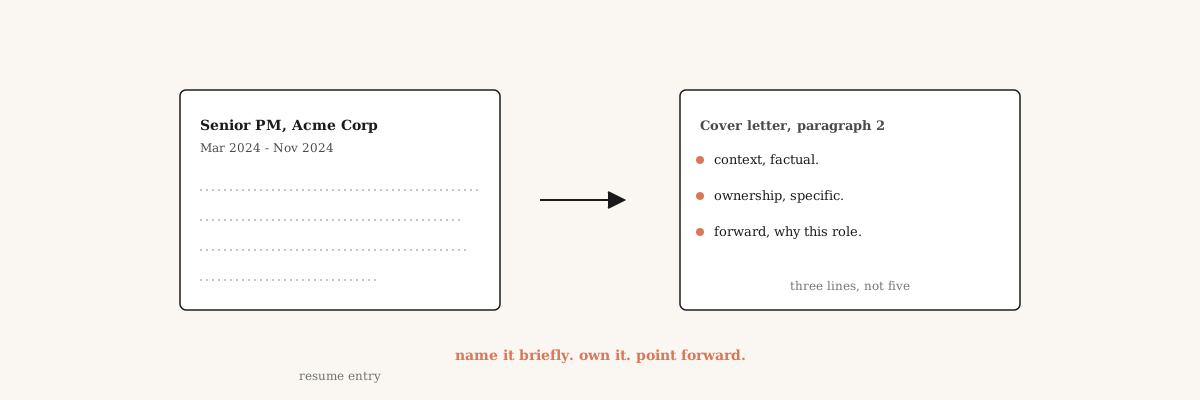
The resume itself should not explain the termination. The resume is a list of jobs and accomplishments. It states what you did, not why each role ended. Your last role goes on the resume the same way the previous ones do: company, title, dates, three to five bullets describing impact.
The explanation goes in the cover letter or the interview. It uses three lines, in this order:
- One line of context. What the role was, what the situation was. Neutral, factual. No emotion.
- One line of ownership. What you would do differently. Specific, not generic.
- One line forward. What you are looking for next, and why this role fits.
Here is an example. Imagine a candidate fired from a senior PM role after eight months because the role pivoted to a domain they had no experience in and the new VP wanted someone with that experience.
"I joined as a senior PM on the data-platform team. Three months in, the team was reorganized under a new VP and the role was repositioned to focus on B2B integrations, which is outside my background. After two attempts to find an internal fit, the VP and I agreed to part ways. Looking back, I would have asked harder questions in the original interview about the platform strategy and how stable the scope of the role actually was. I am looking for a senior PM role on a consumer or growth surface where my last six years of experience apply directly, which is why this role caught my attention."
That is three sentences of context, one of ownership, one forward. Notice what it does:
- It does not say "I was fired" but it does not hide that the role ended badly.
- It does not blame the VP or the company.
- The ownership is concrete. "I would have asked harder questions about scope stability" is something a hiring manager can imagine themselves saying.
- It pivots forward in a way that makes the current role feel like a deliberate next step, not a desperate one.
A recruiter who hears this version is going to call references and find a story that matches. That is what they want. They are not looking for purity. They are looking for a candidate whose story is consistent across the resume, the cover letter, the interview, and the reference call.
What not to do
Do not lie about dates
If you were fired in March, do not write "left in May to pursue other opportunities". The verification call will return March. Mismatched dates are the single biggest reason offers get rescinded after the background check. The recruiter does not care that you were fired. They care that you lied. One is a hiring decision, the other is a trust decision.
Do not pretend it was a layoff
Layoffs and terminations look different on a reference call. If you were the only person let go from a 200-person company in a quarter where revenue grew 12 percent, "I was laid off" is going to ring false. Worse, your former HR team knows the difference. If asked to confirm "was this a layoff?", they will often say "no, it was a termination", which is a fact they are allowed to share even if they cannot share why.
Do not use the word "fired" in writing
This is the inverse of the previous point. You do not need to volunteer the word "fired" on a resume, in a cover letter, or in a screening form. Use neutral language: "the role ended", "we parted ways", "I exited". Save the more direct language for the in-person interview, where you can control delivery. Written words live forever. Spoken words can be calibrated to the room.
Do not over-explain
The biggest mistake in cover letters that mention a termination is length. Three lines is enough. Four is too many. Five is a confession. Hiring managers reading a five-paragraph explanation of why you left your last job are not impressed by the depth of self-reflection. They are wondering why you spent more time on this than on the role they are hiring for.
What to write on the resume itself
Three options, in order of preference.
Option 1: Just list the role like any other
If the dates are not unusual (the role lasted at least nine months) and the title is normal for your seniority, just list it. No annotation. The cover letter or interview handles the explanation.
Senior Product Manager, Data Platform — Acme Corp
March 2024 - November 2024
- Bullet
- Bullet
- Bullet
Option 2: Compress short stints
If the role was under nine months and you have other recent roles, consider compressing it. List dates as "2024" rather than "March 2024 - November 2024". Hiring managers will still ask about it but the resume itself does not draw the eye to the short stint.
Option 3: Group brief tenures
If you have two or three short roles in a row (a layoff, then a misfit role, then another exit), group them under a single line: "Various contract and full-time roles, 2023-2024". List the companies and titles in a single line and explain in the cover letter. This works only if the underlying story is consistent (an industry contraction, a deliberate exploratory phase, a relocation).
The PIP and the asked-to-resign cases
A PIP that ends in resignation is a special case. Legally it is a resignation. Your former employer's HR will say "she resigned" on a verification call. That is the truth they are required to state.
But the underlying experience is closer to a termination. If you were on a PIP and chose to resign before it concluded, the cover letter version of the story is:
"I joined as a [title]. Six months in, my manager and I disagreed on the priorities of the role and on how my work was being evaluated. After a structured performance conversation we agreed I would move on. Looking back, I would have escalated earlier when the priorities started drifting. I am looking for a role where the scope is more clearly defined upfront, which is part of why this position caught my attention."
This is honest. It does not say "PIP" but it does not pretend the role ended on warm terms. It owns a specific behavior change. It points forward.
Hiring managers who have managed people understand the PIP-resignation pattern. They do not need the word. They need to see that you have a story, that you took something from it, and that you are not bitter about it.
The reference question
If the company you were terminated from is going to give you a bad reference, you have three options.
Option 1: Do not list them as a reference
References are usually optional. Provide three from earlier in your career or from peers and reports rather than your former manager. Most companies do not check past references unless the candidate provides them.
Option 2: Check what they will actually say
Some companies allow you to call HR yourself or use a third-party service like The Work Number to verify what their automated response is. If it is just "start date, end date, eligible for rehire: no", you can decide whether the eligible-for-rehire answer is something you want to address in interviews.
Option 3: Address it preemptively
If you know your former manager will say something negative on a reference call, mention it in the final-stage interview before they get to references. Something like:
"Before you reach out to references, I want to be upfront that my last manager and I had a difficult relationship and his read on my performance is not going to be glowing. I have references from [peer], [report], and [previous manager] who can speak to my work. If a verification call comes back as 'not eligible for rehire' from that company, that is the context."
This is risky and you do not always need to do it. Use it when you have a specific reason to believe the reference is going to be actively bad and you want to control the framing.
Where shortlisted.site fits
The hardest part of writing about a termination is that you have to get the framing right while also writing about the job you actually did. People over-explain, sound defensive, or hide the gap and create suspicion.
We built shortlisted.site to handle the resume and cover letter side of this without making you re-write your story from scratch every application. You give us your real history, including the role that ended badly. We generate a tailored resume that lists the role normally, and a cover letter that uses the three-line pattern when the dates or the role context call for it. You can edit the framing line by line before you submit.
The output is not generic. Our fit analysis tells you which roles your background actually rhymes with, so the cover letter argues for the specific match instead of leading with the apology. Most users find that once the explanation is condensed to three lines and lives in the cover letter, the resume stops drawing attention to the gap and starts doing the job it was built for.
You can upload your resume and try the first tailoring pass free. No credit card. Try it here.
A termination on your record is not a career-ending event. A termination plus a story that does not line up with the verification call is. The resume itself does not need to mention it. The cover letter handles it in three lines. The interview answer matches the cover letter. The references match the interview answer.
That is the entire system. The job-search forums make this seem complicated because the people who post about it are panicked and the people who reply are not professionals. The recruiters who hire after a termination on the resume are not heroes and are not unusual. They hire dozens of candidates a year with messy histories. What they screen for is consistency, ownership, and a story that points forward.
Get the three lines right. Put them in the right place. Move on.