The pitch is intoxicating when you're exhausted. You've been manually applying for three months, you're tired, you're anxious, and a service promises to apply to 1,000 jobs a week for you while you sleep. For $100 a month, LazyApply will fire your resume at every remotely plausible listing. Sonara will do roughly the same. Simplify, Loopcv, a dozen others — all selling the same dream.
By early 2026, the verdict is in, and it is not the one the ads wanted.
Auto-apply bots are, measurably, a net-negative for most job seekers. Not just inefficient. Actively worse than doing nothing, in some cases. Here is what 100+ user reports across r/jobs, r/cscareerquestions, and Trustpilot have documented, plus what actually happens when a bot applies on your behalf.
The representative case
A widely-shared comparison from a 2025 Reddit user:
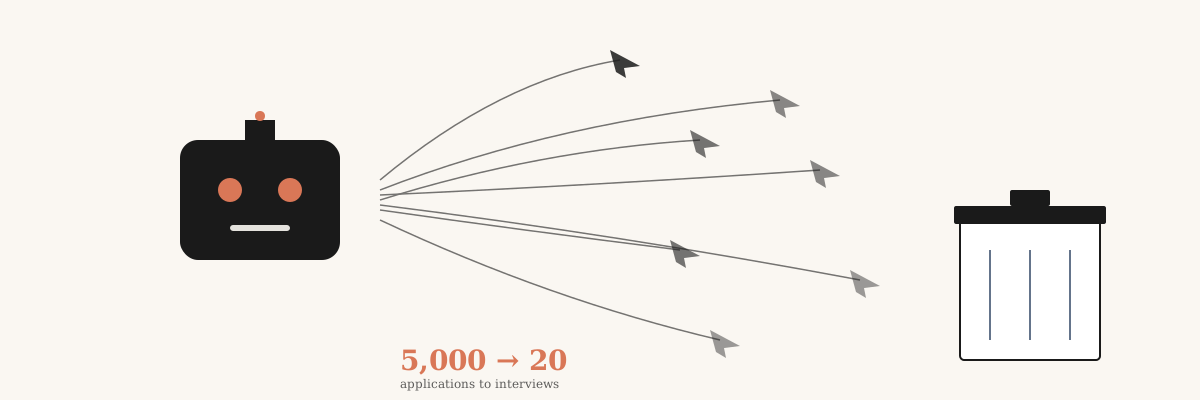
- With LazyApply: 5,000 applications over 6 weeks. 20 interviews. Conversion rate: 0.4%.
- Without LazyApply, manually targeted, same candidate: 200 applications over 6 weeks. 20 interviews. Conversion rate: 10%.
Same candidate. Same outcome. 25x more effort with the bot.
That's not a rare data point. It's the median report. Search r/cscareerquestions or r/jobs for "LazyApply review" or "Sonara review" and you'll find dozens of users running essentially the same comparison with essentially the same result: the bot hits a volume ceiling, and the volume doesn't translate to interviews.
Worse — many users report that the bot's applications generated such obvious signals of mass-applying that they suspect their name is now on recruiter block lists. You can't easily walk that back.
Why the bots are structurally bad
1. The filter catches you faster than you think
Most modern ATSes flag mass-apply patterns. Applications submitted within seconds of each other from the same IP, applications where all screening questions are answered identically, applications where the cover letter is the word "Dear Hiring Manager" and nothing else — all of it gets deprioritized or auto-rejected before a human sees it.
A veteran recruiter quote from a late-2025 LinkedIn post: "We see the LazyApply applications come in. They're visible to us. We don't read them. It's not even a judgment call anymore."
2. The screening questions get answered wrong
Every application has 5–15 screening questions. Years of experience. Salary expectations. Authorization to work. Remote preferences. The bot has to guess on all of them, and it guesses identically across every application. The result:
- On a role where you meet all requirements, the bot still answers "3 years" because that's your default — and the role required 5+, so you're rejected despite being qualified.
- On a role with a required location, the bot checks "yes" to everything, and you end up applying to roles you'd never accept.
A common r/jobs screenshot: "LazyApply filled my middle name field with the word 'middle' because I don't have one. Every application looked broken."
3. You're applying to jobs you don't want
Bots apply based on keywords. They match "Product Manager" to every role with "Product Manager" in the title — including director-level roles you're underqualified for and associate-level roles you're overqualified for, plus product marketing, product ops, and a dozen other adjacent functions. You end up with:
- Interviews for roles you actively don't want (and now have to politely decline, burning recruiter goodwill).
- Rejections for roles you would never have applied to manually, which stack up in your LinkedIn history and degrade your apparent selectivity.
- Zero interviews for the roles you'd actually accept, because the bot wasted your ammunition on mismatched applications first.
4. The technical failure rate is high
Multiple user reports document 25–40% of Sonara applications failing silently — email verification errors, captchas, malformed form submissions, sessions expiring mid-apply. You paid for 1,000 applications. You got 600 that actually submitted and 400 that didn't, and the dashboard reports 1,000.
5. You generate recruiter noise at scale
When a recruiter posts a role, they see the Easy Apply flood — 500 applications in two hours. They know most of those are bots. The defense, increasingly, is to ignore the Easy Apply pool entirely and reach out manually to candidates they surfaced via LinkedIn Recruiter. That means the path to the job is outside the application system, and the bot has you firing into a channel nobody's reading.
The shame spiral
The emotional cost gets less attention than it should. If you've used an auto-apply bot, you probably know this feeling:
- You paid money for a shortcut, and the shortcut didn't work.
- You feel like you cheapened your search.
- You're embarrassed to admit it — in threads, to friends, to yourself.
- You're now further from an offer than when you started, but you've spent more money and more weeks.
- The natural response is to blame yourself: "I should have kept doing it manually."
That shame is what keeps the bot category alive. Users who regret it don't talk loudly. The ones still in the "just started, hope peaking" phase are the voices in the marketing.
What actually works instead
1. Drastically cut your target list
Start by accepting that you cannot apply to 1,000 roles in any way that produces outcomes. Not manually, not with a bot, not with AI assistance. The ceiling is maybe 25 serious applications per week, and even that's pushing the sustainable limit.
2. Vet every listing for 30 seconds before applying
Ghost job? Skip. Posted 45+ days ago? Skip. Salary range non-existent? Skip. Company shrinking? Skip. The triage cuts your applicable list by 30–50% and your odds on the remaining go up dramatically.
3. Tailor, but efficiently
The 13-minute tailoring workflow from our tailoring fatigue piece — rewrite the top half of page 1, mirror JD language in 3 bullets, customize paragraph 1 of the cover letter, submit. Not 2 hours. Not 2 minutes.
4. Apply through company sites, not aggregators
Same resume, same cover letter, higher response rate — because you bypassed the noisy Easy Apply / aggregator pool and landed in the quieter direct-apply pool where recruiters are actually reading.
5. Reach out to the recruiter directly
After applying, find the recruiter on LinkedIn and send a 2-sentence message: "I applied for the Senior PM role. Happy to answer any questions. Here's the one-sentence version of why I'd be a fit: [sentence]." This doubles your visibility in the recruiter's stack, and bots can't do it.
The AI framing confusion
Part of the reason auto-apply bots sell is that "AI" has become a monolithic word. Users see "AI job tool" and imagine the tool is smart on their behalf. In reality there are two completely different categories:
- Volume AI: LazyApply, Sonara, Simplify. The AI fires applications at scale. Scales volume, degrades signal.
- Quality AI: Fit analysis, tailored resume generation, smart job discovery. The AI helps you identify the right roles and present yourself well. Scales signal, keeps volume sane.
These are opposite approaches sold under the same word. A user who's been burned by volume AI often swears off AI tools entirely — which is a shame, because the category that would actually help them is being thrown out with the bathwater.
Where shortlisted.site fits
We built shortlisted.site as explicitly the opposite of LazyApply.
Our product does not apply to jobs on your behalf. It does not promise to submit 1,000 applications a week. It will never auto-fire your resume at random postings. If you want that, go elsewhere — and we genuinely wish you luck.
What we do: we analyze your fit on every role you consider, tell you honestly whether you rank in the top 15 of applicants or somewhere in the middle, and — for the roles where you actually stand out — generate a tailored resume and cover letter that mirrors the JD's language where your experience really matches.
The goal is to get you to 25 strong applications a week, not 500 mediocre ones. Fewer applications. Higher response rate. Lower burnout. That's the entire pitch.
If you've just come off a bad LazyApply experience, we'd especially like to have you. Most of our best users are ex-auto-apply refugees who are done with the volume game and want the intelligent alternative.
You can upload your resume and try a fit analysis free. No credit card. Try it here.
Auto-apply bots sell you volume. Volume sells you the feeling of action. The feeling of action is not the same as the outcome of an interview.
The data, the recruiter reports, and the user reviews all say the same thing: a bot sending 5,000 applications gets you roughly the same (or worse) results as thoughtful manual applying at 1/25th the volume. And the emotional cost of the bot's failure — shame, burnout, distrust of "AI tools" — is worse than the slow grind of doing it right.
There is no shortcut to an interview. There is a much faster, AI-assisted way to do the non-shortcut version. That's the real category.